Replacing a fan
A fan that is already there, swapped in one visit.
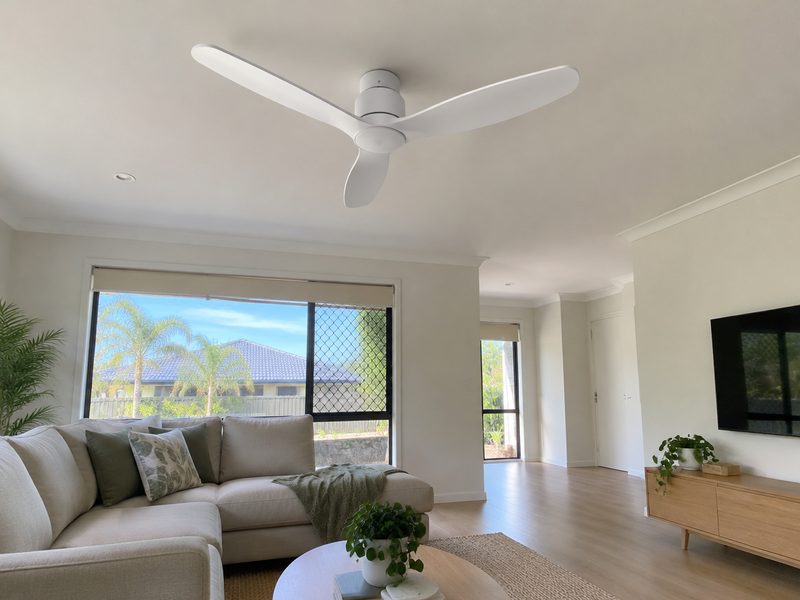
Most fan jobs in Bundaberg are a straight swap: the old fan is tired, wobbly or noisy, and the wiring and the wall switch are already in place. With the fan supplied by you, the electrician takes the old fan down, checks the ceiling fixing can carry the new one, fits the new fan to the maker's instructions, connects it to the existing wiring, then runs it on every speed to check it is balanced and quiet. The old fan goes in the van unless you want to keep it. Most fan swaps are done in one visit, and we price the lot on the phone whether you book one or three.
A new position
A fan where there was none: priced on the phone.
Putting a fan where there was only a light, or nothing at all, means a new fixing in the ceiling, a cable run from the nearest light circuit and a wall control for the speeds. We give you the price on the phone, including the switch work. Three things move it: how easy the roof space is to get into, how far the cable runs, and whether the existing light switch can take the fan control or a new one has to be cut in beside it.
Lights and remotes
Fans with a light and remote.
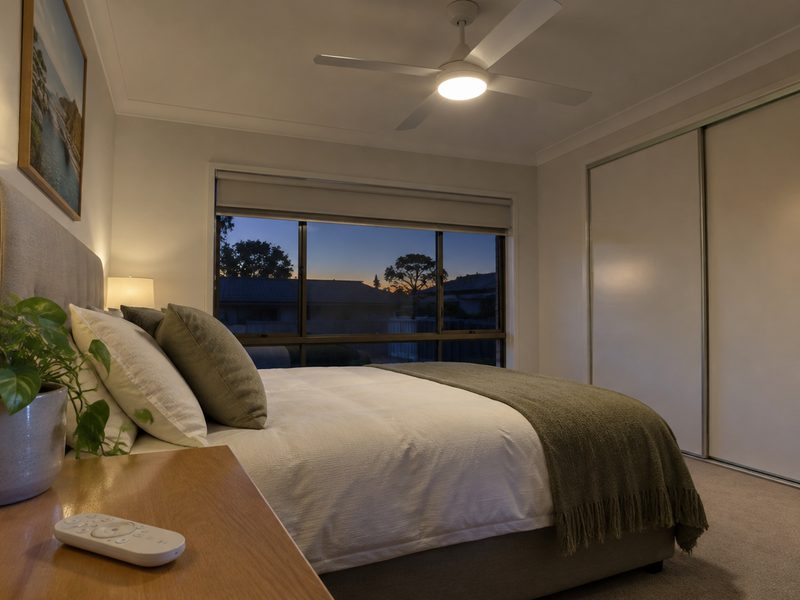
A fan with a light kit and a remote replaces an existing fan the same way, at the same hourly rate. The remote's receiver sits inside the fan canopy and the light wires into the fan, so there is no extra cabling. If your old fan used a wall controller with speed settings, we leave the wall switch as a plain on-off and the remote does the rest.
Outdoors
Patio, deck and alfresco fans.
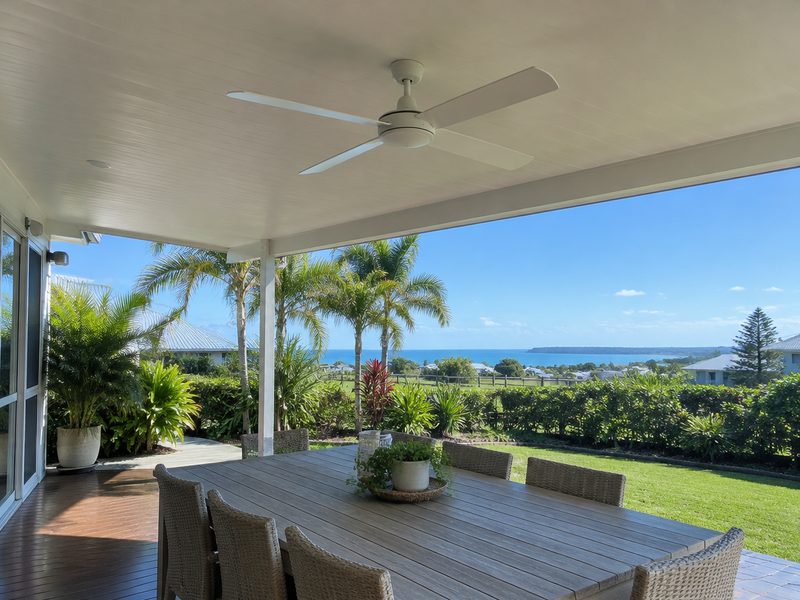
An outdoor fan has to be rated for it. Bargara, Burnett Heads and anywhere near the coast get salt in the air, and an indoor fan rusts and seizes within a couple of summers. Buy a fan sold as outdoor or coastal rated, with ABS or stainless parts, and we fit it like any other replacement where a fan already exists. A new patio fan with no wiring is quoted like any new position, with the circuit checked for a safety switch.
Which fan
What we recommend, and why.
- DC motor. A DC fan uses roughly a third of the power of an older AC fan, is quieter, has more speeds and usually comes with a reverse setting for winter. It costs more to buy and takes no longer to fit.
- 52 inch for bedrooms, 56 inch for living areas. A 52 inch (1300 mm) fan moves enough air for a normal bedroom without the blades crowding the room. Living rooms and open-plan kitchens want 56 inch (1400 mm) or bigger, or two fans.
- Blades and height. Timber or ABS blades stay quiet; thin metal blades hum. Blades need about 2.1 metres from the floor, so a low ceiling wants a low-profile fan and a high one an extension rod.
Any big-brand fan from the hardware or lighting shops is fine. If you want us to supply it, say so when you book and we quote one on the phone.
Before the visit
What to have ready.
Have the fan in the room, in its box, with the light kit, remote and batteries if it has them. Clear the floor and the bed under the fan so the ladder can go up. Tell us on the phone if the ceiling is higher than about 2.7 metres, or raked, so the electrician brings the right ladder and an extension rod. Payment is by card or bank transfer and the invoice is emailed to you.
What we don't do
The work we leave to others.
No emergency or after-hours work (we work Mon to Fri, 8:30am to 4:30pm), no switchboard upgrades or rewires, no solar and no air conditioning. Every other fan job in a house, including replacing the wall controller, fixing a wobble or taking a fan down, is ours.